
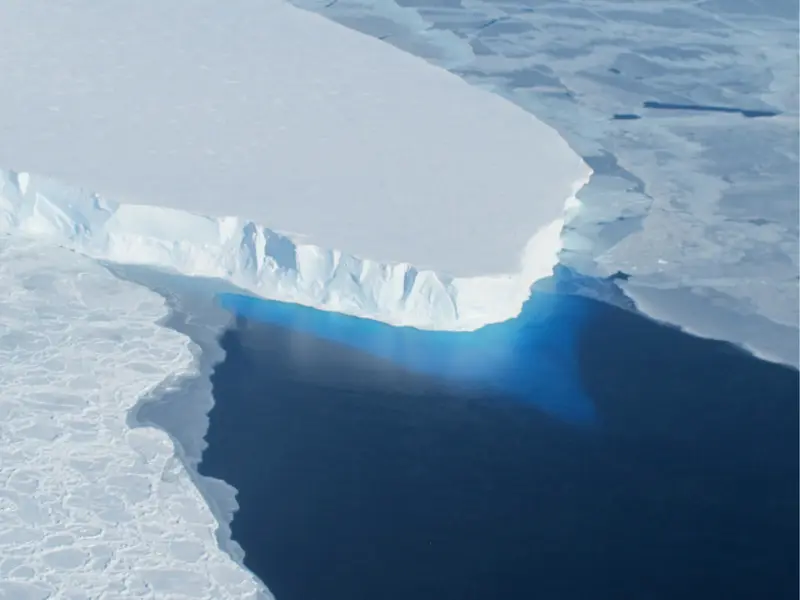
Thwaites Glacier, or Doomsday Glacier, in Antarctica, has been struck by hundreds of earthquakes. Photograph: (NASA/AFP)
Major Catastrophe Unfolding in Antarctica as Hundreds of Earthquakes Slam Doomsday Glacier
A major environmental crisis may be unfolding at the bottom of the world. Scientists have reported hundreds of seismic events striking Antarctica’s infamous Doomsday Glacier, formally known as the Thwaites Glacier. These Doomsday Glacier earthquakes have triggered global concern, as experts warn that the stability of one of Earth’s most dangerous glaciers could be rapidly weakening.
What Is the Doomsday Glacier?
The Doomsday Glacier, or Thwaites Glacier, is one of the largest and most unstable glaciers in Antarctica. It is often called the “Doomsday Glacier” because its collapse could raise global sea levels by more than three feet, threatening coastal cities worldwide.
This glacier acts as a natural barrier holding back massive amounts of ice. If it fails, neighboring glaciers could follow, amplifying the impact on global sea levels.
Hundreds of Earthquakes Detected Beneath the Ice
Recent studies reveal that hundreds of small but frequent earthquakes have been detected beneath and around the Doomsday Glacier. These Doomsday Glacier earthquakes are believed to be caused by intense stress within the ice as it fractures, shifts, and slides over the rocky bed below.
Scientists used advanced seismic sensors buried deep in the ice to record these tremors, many of which are invisible on the surface but extremely significant beneath the glacier.
Why Are These Earthquakes So Alarming?
Unlike typical tectonic earthquakes, these seismic events are known as “icequakes.” They occur when massive ice sheets crack or rapidly move. The growing frequency of Doomsday Glacier earthquakes suggests the glacier is becoming more unstable.
Researchers warn that these icequakes could accelerate ice flow toward the ocean, increasing the risk of partial or total glacier collapse.
Link Between Earthquakes and Climate Change
Rising global temperatures are playing a crucial role in this crisis. Warmer ocean waters are melting the glacier from below, weakening its base. As the ice loses grip on the bedrock, it becomes more prone to sudden movements, triggering earthquakes.
Climate change has also increased surface melting, allowing water to seep into cracks and further destabilize the glacier’s structure.
Potential Global Impact of Doomsday Glacier Collapse
If the Doomsday Glacier were to collapse entirely, the consequences would be catastrophic. Scientists estimate global sea levels could rise dramatically, flooding low-lying regions and displacing millions of people.
Major coastal cities such as New York, Mumbai, London, and Shanghai could face severe flooding. Island nations would be among the first to experience devastating impacts.
What Scientists Are Saying
Experts describe the current situation as a warning sign. The increase in Doomsday Glacier earthquakes indicates that the glacier is undergoing rapid internal changes.
Some scientists believe these seismic events could represent the early stages of irreversible collapse, while others say more data is needed. However, all agree that the glacier is in a highly vulnerable state.
How Scientists Are Monitoring the Situation
International research teams are using satellites, drones, radar systems, and seismic sensors to closely monitor the Doomsday Glacier. Real-time data helps scientists track ice movement, crack formation, and earthquake patterns.
Upcoming space missions and improved climate models are expected to provide more accurate predictions about the glacier’s future behavior.
Why This Matters Beyond Antarctica
What happens in Antarctica does not stay in Antarctica. The destabilization of the Doomsday Glacier could reshape coastlines around the world and disrupt ecosystems, economies, and human settlements.
The surge in Doomsday Glacier earthquakes serves as a stark reminder of the accelerating consequences of climate change and the urgent need for global action.
Conclusion
The increasing number of Doomsday Glacier earthquakes signals a potentially catastrophic turning point for Antarctica and the planet. As scientists race to understand and monitor this unfolding crisis, the world watches with concern. The fate of the Doomsday Glacier may ultimately determine the future of global sea levels and coastal life across Earth.
